Performance profile
Profiling results from motel's engine benchmarks on an Apple M1 (8-core, 16GB). Run with Go 1.25 and the OTel Go SDK v1.40.
Throughput ceiling
The engine's throughput is primarily controlled by the inter-arrival sleep in the main loop, not by CPU. However, trace generation time is additive to the sleep interval, so the effective rate is lower than the target — particularly at high rates where the per-trace generation time becomes a significant fraction of the interval:
| Target rate | Actual spans/sec | Spans per run (1s) | Allocs/run |
|---|---|---|---|
| 100/s | 363 | 364 | 5,209 |
| 1,000/s | 3,440 | 3,443 | 49,080 |
| 5,000/s | 16,470 | 16,475 | 234,120 |
| 10,000/s | 32,070 | 32,077 | 457,120 |
The test topology produces ~3.6 spans per trace (gateway, backend, database, cache). At 10,000 traces/s the engine produces ~32,000 spans/s with a noop exporter rather than the theoretical ~36,000, because each ~4 us trace generation eats into the 100 us inter-arrival interval. This is still well above the rate at which most collectors start dropping data, so motel is not the bottleneck at any rate in the stress-test guide.
Per-span cost
From BenchmarkWalkTrace with a 4-service topology (4 spans/trace):
- ~3,900 ns/trace (~975 ns/span)
- 6,112 bytes/trace (~1,528 bytes/span)
- 54 allocs/trace (~13.5 allocs/span)
Most allocation comes from the OTel SDK, not from motel's engine code:
| Source | Share of alloc_space |
|---|---|
OTel newRecordingSpan |
40% |
OTel SetAttributes (slice grow) |
27% |
motel walkTrace (attr slices, maps) |
24% |
| OTel span options | 9% |
CPU hot paths
From a CPU profile of BenchmarkWalkTrace (4-service topology, noop exporter):
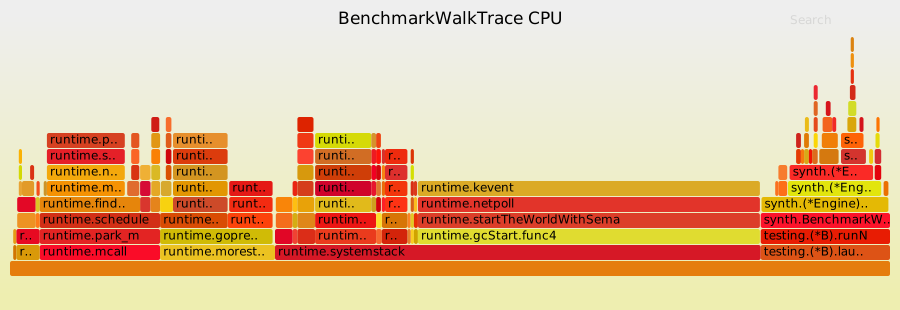
The flamegraph shows walkTrace and executeCall as the widest application
frames, with the OTel SDK ((*tracer).Start, newRecordingSpan,
SetAttributes) underneath. Runtime and GC are visible but modest.
To reproduce this flamegraph:
go test -run=NONE -bench=BenchmarkWalkTrace -benchtime=5s \
  -cpuprofile=cpu.prof ./pkg/synth/
go tool pprof -raw cpu.prof | stackcollapse-go.pl | flamegraph.pl > flamegraph.svg
Sample pprof -text output from the same profile:
      flat  flat%   sum%        cum   cum%
     0.24s  2.11% 46.52%         4s 35.24%  synth.(*Engine).walkTrace
     0.03s  0.26% 46.78%      2.91s 25.64%  synth.(*Engine).executeCall
     0.05s  0.44% 47.22%      1.76s 15.51%  sdk/trace.(*tracer).Start
     0.25s  2.20% 49.43%      1.15s 10.13%  sdk/trace.(*tracer).newSpan
     0.17s  1.50% 54.01%      0.67s  5.90%  sdk/trace.(*recordingSpan).SetAttributes
The engine's own logic (walkTrace + executeCall) accounts for about 60% of
CPU, with the OTel SDK taking the remaining 40%. GC pressure is modest at ~5%.
stdout vs OTLP export
Benchmark allocations at 1,000 traces/s for 1 second (noop exporter vs stdout
writing to io.Discard):
| Exporter | Spans/sec | Allocs/run | Bytes/run |
|---|---|---|---|
| noop | 3,456 | 49,270 | 5.5 MB |
| stdout (discard) | 3,130 | 187,640 | 13.4 MB |
stdout serialisation adds ~3.8x more allocations and ~2.4x more memory per run.
CPU usage
Measured with /usr/bin/time on the real binary over a 10-second run with a
4-service topology. CPU percentage is user+sys time divided by wall time,
representing usage of a single core:
| Target rate | stdout CPU | OTLP CPU |
|---|---|---|
| 1,000/s | 14% | 6% |
| 5,000/s | 28% | 13% |
| 10,000/s | 39% | 20% |
OTLP export (to a local collector with a noop exporter) uses roughly half the CPU of stdout, because the OTel SDK batches spans and the collector handles serialisation.
When does motel fall behind?
With OTLP export, motel keeps pace at all tested rates up to 10,000 traces/s.
With --stdout, the synchronous JSON serialisation becomes a bottleneck at
high rates. At a target of 10,000 traces/s, the stdout exporter achieves only
~5,900 traces/s (~23,500 spans/s). For rates above ~5,000 traces/s, use OTLP
export instead.
If you see interval drift (actual rate lower than target), check:
- Whether you're using
--stdout— switch to OTLP for high rates - Collector queue depth and retry backoff
- Network latency if sending OTLP to a remote endpoint
Profiling a live run
motel includes a --pprof flag that starts a pprof HTTP server:
motel run --pprof :6060 --stdout --duration 30s your-topology.yaml > /dev/null
Then in another terminal:
# CPU profile (30-second sample)
go tool pprof 'http://localhost:6060/debug/pprof/profile?seconds=30'

# Heap profile
go tool pprof http://localhost:6060/debug/pprof/heap

# Goroutine dump
curl 'http://localhost:6060/debug/pprof/goroutine?debug=2'
To generate a flamegraph from a live run:
# Save a 30-second CPU profile
curl -o cpu.prof 'http://localhost:6060/debug/pprof/profile?seconds=30'

# Convert to flamegraph (requires flamegraph.pl and stackcollapse-go.pl)
go tool pprof -raw cpu.prof | stackcollapse-go.pl | flamegraph.pl > flamegraph.svg
Recommendations
- For collector stress testing, 5,000-10,000 traces/s is safe with OTLP export. At 10,000 traces/s motel uses ~20% of one core, leaving ample headroom
--stdouttops out at ~5,000-6,000 traces/s. Use it for debugging and small-scale testing. For sustained high-rate runs, use OTLP export- The per-span allocation cost (~1.5 KB, 13 allocs) is dominated by the OTel SDK. Reducing motel's own allocations would yield diminishing returns
- If profiling a specific topology, use
--pprof :6060andgo tool pprofto identify whether the bottleneck is motel, the exporter, or the collector